
RECONCILING THE MANUAL J AND PHPP
Two "official" load numbers for the same building, 1.80x apart.
That's what our Manual J/S/D and PHPP models came back with on a Longmont, Colorado duplex: Manual J at 30,384 Btu/h building-wide, PHPP at 16,920 Btu/h.
If you build to Passive House standards and still have to produce a Manual J for permit, you've seen a version of this gap before — sometimes 20%, sometimes well over 100%, and it tends to widen as the envelope gets tighter. It's rarely a mistake on either side. Left unreconciled, though, two "official" numbers for the same building erode confidence in both of them, right when a builder or an inspector is deciding which one to believe.
Here's the process we ran to turn that gap into a design decision instead of a credibility problem.
A load calculation isn't a fact about the building. It's an answer to a question — and Manual J and PHPP are asking different questions.
If it were up to us, PHPP would be the single source of truth, full stop. Colorado's code doesn't allow that: Manual J, D, and S are required regardless of what the energy model shows. So we produce both, and make them talk to each other.
→ Respect both questions.
Manual J is a defensive instrument: coldest hour, -2F, a 72F ΔT, zero credit for solar or internal gains. PHPP asks something different — real gains, real airtightness, a milder ~19F design temperature. Both are correct. They're just answering different questions.
→ Reconcile in writing, before anyone orders equipment.
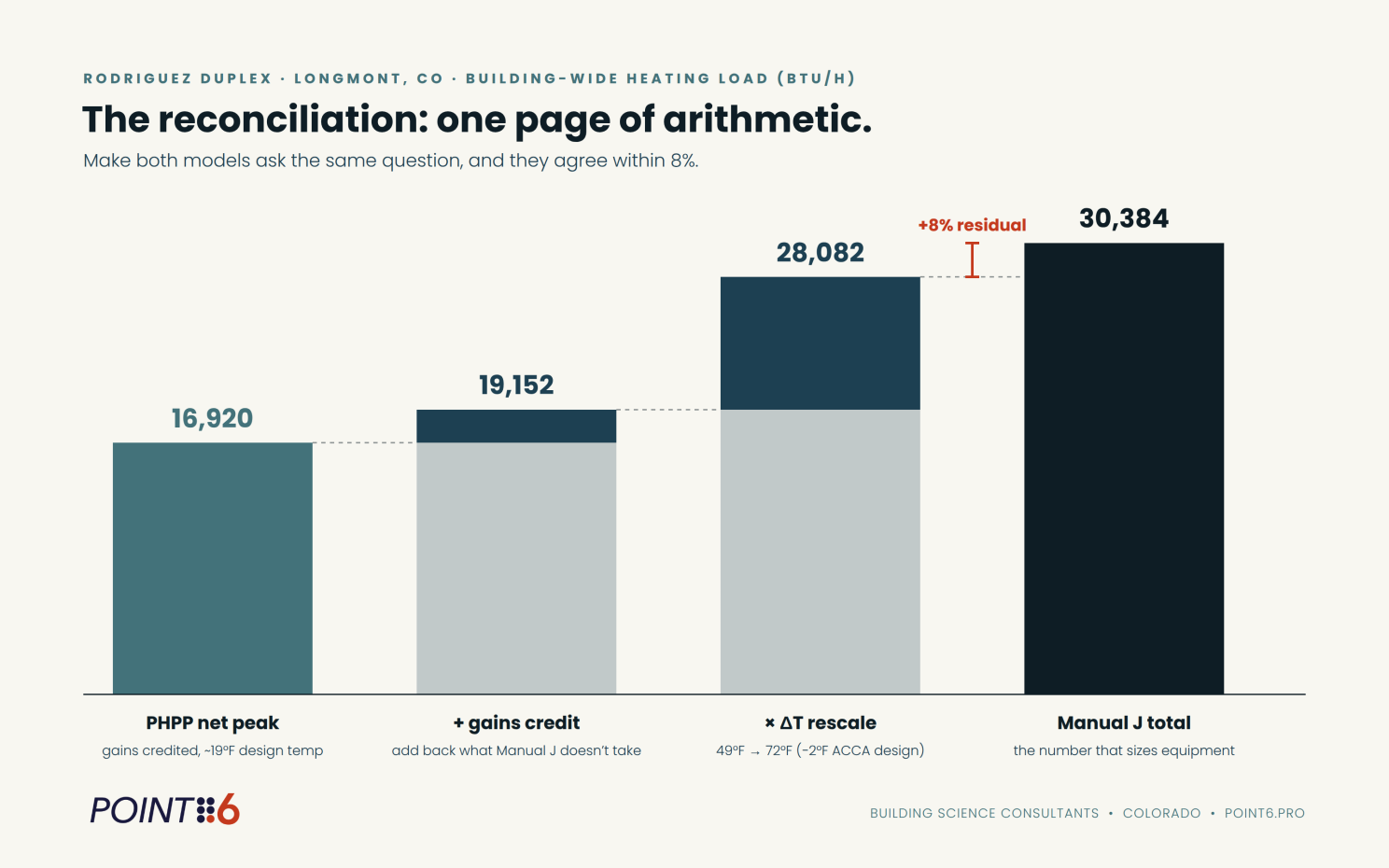
Start with PHPP's net peak (16,920 Btu/h). Strip the gains credit Manual J doesn't take (19,152). Rescale the ΔT from 49F to 72F (28,082). Compare to Manual J's actual total (30,384). Residual: +8%. Two-thirds of the original 1.80x spread was nothing but design temperature. Most of the rest was Manual J's deliberate conservatism on gains.
→ Tighten the record.
Reading the two reports side by side catches real errors too — a cooling calc that assumed humid-climate air instead of Colorado's dry Front Range wet bulb, a ventilation basis still on ASHRAE defaults instead of our actual ERV, a mechanical loft quietly adding 12% to the load with no air even delivered to it.
→ Size the equipment deliberately.
The Manual J load is what sizes the equipment — with Manual S discipline. Our 1.5-ton Mitsubishi Hyper-Heat pairing is rated at 135% of the unit load, inside Manual S's 150% ceiling for variable-capacity heat pumps, and turns down to 56% of the load — comfortably under Manual S's 80% turndown requirement.
Two calculations, verified against each other, is evidence. And evidence is what lets a 1.5-ton heat pump feel like a confident decision instead of a leap.