
Colorado's New Energy Code, Explained
Colorado has a new statewide model energy code — the Model Low Energy and Carbon Code, or MLECC. It became the state minimum on July 1, 2026, and it applies to a given project once that project's jurisdiction adopts it.
Here's what the code is, what's in it, and what changes for the people who design and build here. This covers the residential provisions; the commercial side is a separate piece.
What the MLECC is
The Model Low Energy and Carbon Code — MLECC, sometimes written LECC — is a modified version of the 2024 International Energy Conservation Code, with Colorado amendments layered on top.
It was developed by the state's Energy Code Board, published by the Colorado Energy Office on September 2, 2025, and printed by ICC in January 2026. It's the last of three model codes the legislature ordered in HB22-1362, following the 2023 Model Electric Ready and Solar Ready Code.
It is a model code. The state doesn't enforce it. Individual jurisdictions adopt it, and until one does, it doesn't govern anything in that jurisdiction.
How it becomes your code
HB22-1362 doesn't require every jurisdiction to adopt a new energy code on a set date. It attaches the requirement to a jurisdiction that already has and enforces building codes, and it fires the next time that jurisdiction updates a code.
The statute sets two windows:
A city or county that updated building codes on or after July 1, 2023 and before July 1, 2026 had to meet the 2021 IECC plus the Model Electric Ready and Solar Ready Code — or an equivalent or more stringent code. The Energy Office also accepts the 2024 IECC here.
A city or county that updates on or after July 1, 2026 has to meet the MLECC, or something more stringent.
The Energy Office states the trigger plainly: jurisdictions must adopt the minimum energy code "when they adopt or update any other building code," excluding the Colorado Wildfire Resiliency Code.
The carve-outs go further than the wildfire code. The statute also lets a jurisdiction update the National Electrical Code, the Colorado Plumbing Code, and the elevator and escalator code on their own cycles without triggering the energy code duty. Counties under 30,000 population that applied for a state adoption grant and didn't get one can fall back to one of the last three IECC editions.
The practical result: a city that adopted a fresh code package in May 2026 is set for this cycle. A city that adopts one next spring inherits the MLECC. Same state, same statute, different floor — determined by the local adoption calendar.
Where Front Range jurisdictions actually sit
Worth checking against your own permit jurisdiction. As of early August 2026:
Denver — 2025 Denver Building and Fire Code, adopted June 13, 2025, effective December 31, 2025. Built on the 2024 I-codes with one exception: the energy code. Denver's own page states the base code "stays the same using IECC-2021."
Fort Collins — 2024 IBC, IRC, and 2024 IECC with local amendments, effective April 1, 2026. The city says the 2021 codes "will be available for reference until Oct. 1, 2026."
Boulder — 2024 City of Boulder Energy Conservation Code, approved June 6, 2024, effective December 1, 2024, adopted alongside the 2024 ICC suite.
Broomfield — 2021 I-code series including 2021 IECC, effective April 15, 2023.
Four jurisdictions, four different energy code floors, none of them currently the MLECC. All of them compliant with state law.
There is no published state tracker of which jurisdictions have adopted the MLECC since July 1. We looked. The Energy Office publishes the code, the amendment package, and an adoption toolkit — but no adoption list.
Compliance paths, and how house size restricts them
Section R401.2 keeps the familiar paths — prescriptive, simulated performance (R405), and ERI (R406) — but adds two things. R409, the electric-ready, solar-ready, and EV-ready package, is now mandatory on every path. And path choice is restricted by conditioned floor area.
The size tiering is the single biggest change for residential designers, and it doesn't live in one section. It shows up in four:
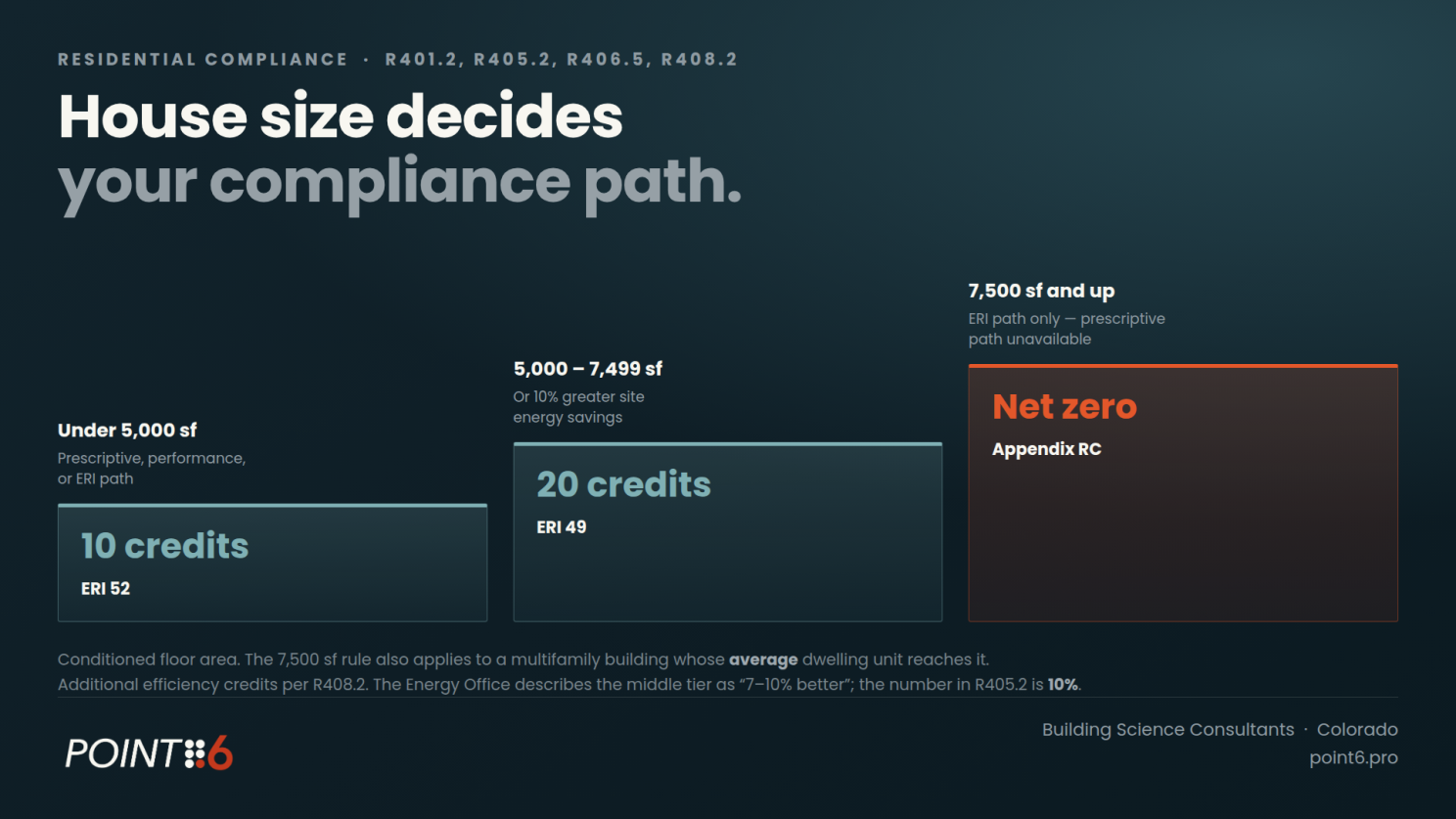
A few notes on that table:
The Energy Office's press release describes the middle tier as "7–10% better." The number in the code — R405.2 — is 10% site energy savings relative to the under-5,000 tier.
Homes at or above 7,500 square feet lose the prescriptive and component-performance paths entirely. ERI is the only route. The same applies to a multifamily building whose average dwelling unit is 7,500 square feet or more.
All-electric space and water heating earns a 5% less stringent site energy target on the performance path, and a less stringent ERI under new section R406.5.1.
What "net zero" actually means here. It's an ERI-based metric, calculated per ANSI/RESNET/ICC 301 — not a measured net-metering result. And there's an important sequence: R406 was amended to remove the separate, stricter ERI score for buildings using on-site power production. That means a large home has to hit the pre-renewables ERI target on envelope and equipment alone, then add generation to reach the Appendix RC target.
Whether off-site renewables — community solar, power purchase agreements, RECs — can count toward that target is one item we could not confirm from primary text. The Energy Office's own ERI checklist lists REC documentation as a mandatory submittal under R406.7.3, which suggests off-site procurement is recognized. Confirm before planning around it.
Envelope requirements
The Energy Office's amendment summary does not amend the prescriptive envelope tables, so these are the 2024 IECC values carried into the MLECC. For the Colorado zones:
ComponentCZ 4BCZ 5BCZ 6BCZ 7CeilingR-49R-49R-49R-49Wood-framed wallR-30, or 20+5ci, or 13+10ci, or 0+20cisamesamesameFloorR-19 or 13+5ci or 15ciR-30 or 19+7.5ci or 20cisameR-38 or 19+10ci or 25ciBasement wallR-10ci or 13R-15ci or 19 or 13+5cisamesameUnheated slabR-10ci, 3 ftR-10ci, 3 ftR-10ci, 4 ftR-10ci, 4 ftVertical fenestration U0.300.28–0.300.28–0.300.27–0.30Glazed SHGC0.40NRNRNR
Most of Denver metro is climate zone 5B.
Air leakage
R402.5.1.3 is amended to state the limit in both air changes and flow per square foot, so either test paradigm works. The Energy Office's amendment summary gives 3.0 ACH50 (or 0.17 cfm/ft²) for zones 4 and 5, and 2.5 ACH50 (or 0.15 cfm/ft²) for zones 6 and 7. One of the state's own calculators shows 2.5 more broadly — worth confirming with your plans examiner before writing it into a spec.
The credit menu — R408.2
Credits are climate-zone specific, and the menu rewards a few things heavily:
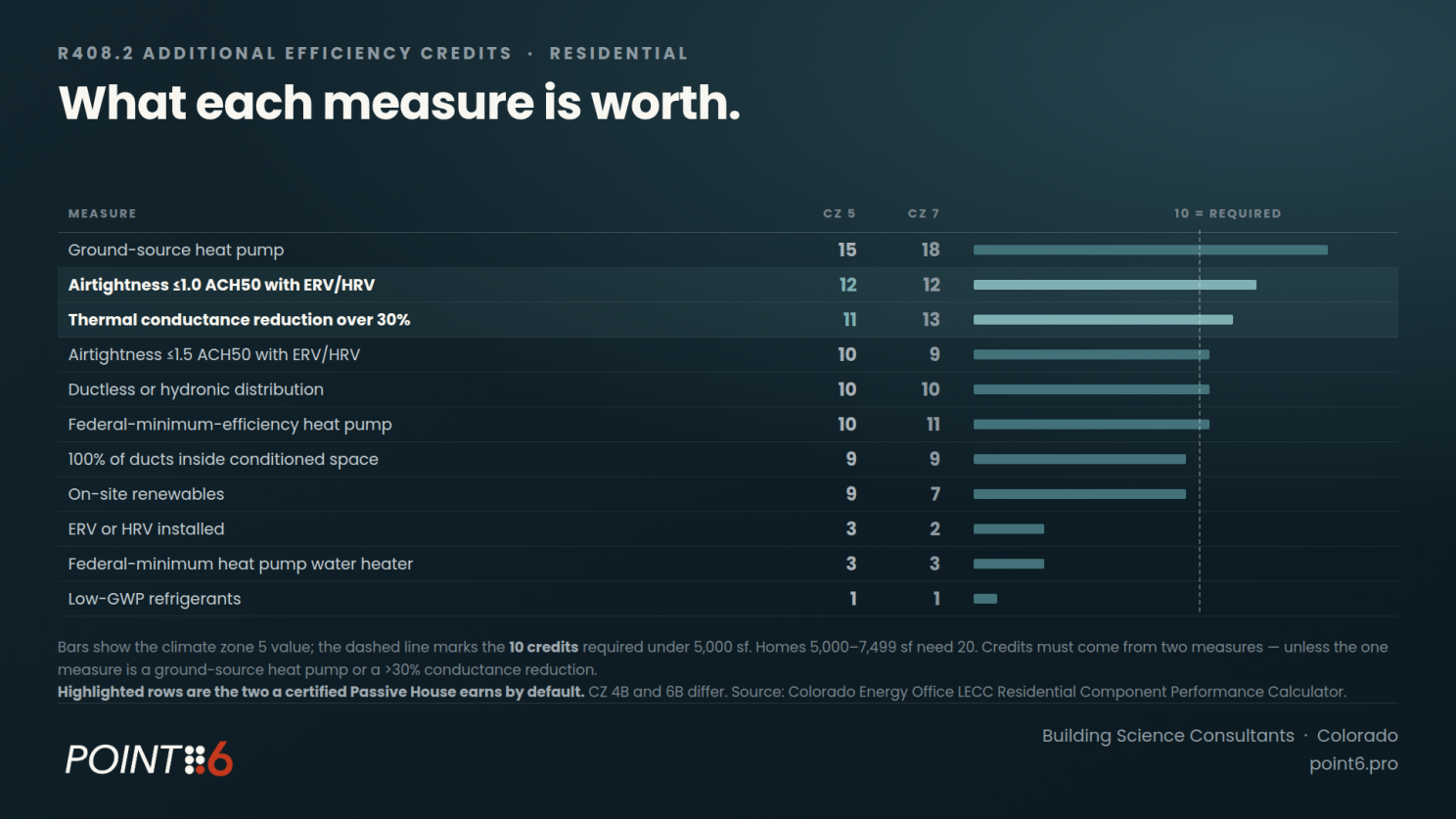
Baseline rule is that credits must come from at least two measures — with a new exception allowing a single measure if it's a ground-source heat pump or a reduction in thermal conductance over 30%.
Demand response
R403.5.4 requires residential water heating to be demand response capable. The Energy Office's plan review checklist scopes this to electric storage water heaters from 40 to 120 gallons, with controls per AHRI 1430 (I-P). It's a mandatory, non-tradable item, so it applies on the performance and ERI paths too.
What a designer has to do: specify equipment listed as demand response capable and call it out on the schedules and construction documents. The code requires capability, not enrollment. Nobody has to sign up for a utility program.
Fuel debiasing: what actually changed
The press release language — the code will "for the first time, fairly credit energy savings from high-efficiency electric heating and water heating" — describes four distinct residential mechanisms:
The metric changed. The performance path (R405.2) now evaluates compliance on site energy, not energy cost. This is the big one. Cost-based metrics have systematically favored gas equipment in markets where gas is cheap per unit of delivered energy.
The reference design changed. Table R405.4.2(1) now models higher-efficiency equipment against the lowest efficiency equipment available, rather than the lowest efficiency in its own class — which is what previously let a code-minimum furnace score as equivalent to a heat pump.
All-electric buildings get a relaxed target. 5% less stringent on site energy savings (R405.2), plus a less stringent ERI under R406.5.1.
Prescriptive credits reward electric equipment directly. A federal-minimum efficiency heat pump earns 10–11 credits. A federal-minimum heat pump water heater earns 3.
One related change worth naming: R403.7.1 now permits electric resistance space heating only as heat pump supplemental heat, freeze protection, alongside evaporative cooling, or where limited to 2 kW or less.
Electric ready, solar ready, EV ready
The 2023 standalone model code is now folded into the base code as R409, mandatory on all compliance paths, and triggered on new construction, additions, first tenant finishes, and "major renovations" — a threshold each jurisdiction defines at adoption.
Notable additions and flexibilities:
The physical space currently occupied by combustion equipment now counts toward the future-equipment space requirement.
Construction documents must show condensate drainage locations where combustion space or water heating is installed (R105.2).
A new multifamily solar-ready zone requirement (R409.4.3) — 40% of roof area.
"Small parking lot" redefined from 10 spaces or fewer to 15 or fewer, with a percentage requirement rather than a fixed count.
Level 1 charging may substitute for up to 50% of Level 2 EVSE-installed or EV-ready spaces in R-2 occupancies, at three Level 1 per one Level 2.
How Passive House design maps onto this
Passive House is a performance standard, not a compliance path. It doesn't exempt a project from anything in the MLECC. But the way the new code is built happens to line up closely with how a Passive House project is designed anyway — and that's worth understanding, because it changes what compliance costs.
Three specific alignments.
The credit menu rewards what Passive House already requires.
Passive House certification requires 0.6 ACH50 and balanced ventilation with heat recovery. In R408.2 terms, airtightness at 1.0 ACH50 or better with an ERV or HRV is worth 12 credits — more than the 10 a home under 5,000 square feet needs in total. A certified Passive House clears the entire additional-efficiency requirement with a measure it was already committed to.
The envelope does similar work. A reduction in total thermal conductance over 30% relative to the R402 baseline earns 11 credits in climate zone 5, and 13 in zone 7. Passive House envelopes routinely exceed that margin. And under the new single-measure exception, that envelope reduction is one of only two measures that can satisfy the requirement on its own.
Stack the two and a Passive House project is at roughly 23 credits against a 10-credit requirement — enough to cover the 20-credit tier for homes between 5,000 and 7,499 square feet without adding anything. Add the heat pump, the heat pump water heater, and ducts inside conditioned space, all typical, and there's substantial margin left over.
Two caveats worth being straight about. Confirm with your plans examiner that both the airtightness and thermal conductance credits are claimable together — the sections are separate (R408.2.5 and R408.2.1.1), which suggests they stack, but that's a reading rather than a confirmed ruling. And credits are climate-zone specific; the numbers above are zones 5 and 7.
The sequencing is the same.
The code was amended so that a home at 7,500 square feet or more has to hit its ERI target on envelope and equipment before on-site generation counts. Efficiency first, renewables second.
That's the Passive House method exactly. PHI sets a heating demand limit and an airtightness limit that a building has to meet on its own physics, and only then looks at primary energy renewable. A team that has designed to Passive House has already done the thing the code now requires in that order — and because the resulting heating and cooling loads are small, the solar array needed to close the remaining gap is smaller and cheaper than it would be on a code-minimum envelope of the same size.
For large custom homes on the Front Range and in the mountain towns, this is where the alignment matters most. The net-zero tier is the hardest requirement in the residential code, and a low-load envelope is the most direct way through it.
The metric moved toward how Passive House already models.
Compliance on the performance path is now evaluated on site energy rather than energy cost. PHPP — the Passive House Planning Package — works in delivered and primary energy, not utility cost. A team already modeling in PHPP is thinking in units the new code recognizes, and the equipment comparisons that PHPP produces line up with what the amended reference design in Table R405.4.2(1) is trying to capture.
Where Passive House doesn't help.
Worth saying plainly, because the honest version is more useful than the pitch.
R409 — electric ready, solar ready, EV ready — is prescriptive infrastructure. Conduit, reserved breaker space, roof zones, parking counts. Passive House says nothing about any of it, and a certified project still has to satisfy every line.
Demand response capability is a product listing question. You specify a water heater that carries the right listing, or you don't. Design approach is irrelevant.
And Passive House certification is not, by itself, a compliance path under the MLECC. Some jurisdictions elsewhere accept Passive House certification in lieu of a HERS or ERI rating — Denver's own Green Buildings Ordinance has an alternative compliance provision — but that's a local question, and it needs confirming with the building department rather than assumed.
The accurate summary: Passive House doesn't shorten the compliance process. It means most of the work the new code asks for is work you were already doing, with margin to spare — and it front-loads the hardest requirement, the net-zero tier, into the part of design where it's cheapest to solve.
What this means going forward
For architects. The size tiers change early conceptual work. A 7,600-square-foot house is a fundamentally different compliance project than a 7,400-square-foot one — it loses the prescriptive path, has to model to a net-zero ERI target, and has to get there on envelope and equipment before renewables count. That's a schematic-design conversation, not a permit-set conversation.
For builders. The credit menu rewards airtightness and duct placement more than most crews expect. Nine credits for keeping ducts inside conditioned space, twelve for hitting 1.0 ACH50 with balanced ventilation. Those are achievable with crew training and sequencing rather than expensive equipment — and they're the measures that also produce a more comfortable, more durable building.
For MEP engineers. Fuel debiasing changes the arithmetic on equipment selection, and demand response capability is now a specification item on water heaters. Verify listings early — availability, not code language, is usually what bites.
For everyone. The single most useful habit right now is confirming which code actually governs your project, with the building department, in writing. State-level summaries — including this one — describe a model. Your permit is issued against a local adoption.
Free resources most firms don't know about
The Energy Office funds several things that are genuinely useful and don't cost anything:
The Colorado Building Code Helpline. Design teams, builders, and building departments can submit code questions and get an answer from a subject matter expert within two business days. It covers whether a design complies and how a measure gets reviewed or inspected.
Free customized training — bi-weekly webinars, on-demand and role-based training, and blower door training, delivered through partner organizations.
Free technical assistance for projects and jurisdictions.
The Energy Code Adoption Toolkit, which is the single most useful link here. It contains the plans examiner and inspector checklists, designer prescriptive and performance checklists, the Residential Component Performance Calculator, and cross-edition change matrices comparing 2024 IECC, MLECC, and DRCOG amendments. Everything cited above came out of it.
All linked from energyoffice.colorado.gov/building-energy-codes-toolkit.
On cost
There's less published analysis than the topic deserves. We found no Energy Code Board incremental-cost or payback study.
What exists: the Energy Office cites a National Association of Home Builders analysis finding that moving from the 2021 to the 2024 IECC would reduce new home construction costs in most Colorado regions — by $3,900 for gas-heated homes and $6,750 for heat-pump-heated homes. The Energy Office's own materials describe the MLECC as cheaper and less complex to comply with than the unamended 2024 IECC.
The Colorado Association of Home Builders has pushed back, arguing affordability is governed by purchase price rather than utility bill savings. Both positions are on the record; neither has a Colorado-specific MLECC cost study behind it yet.
The short version
Colorado's model energy code is now a modified 2024 IECC. It applies to your project when your jurisdiction next updates a building code — not on a statewide date. Most of the Front Range hasn't crossed that line yet.
When it does apply: house size determines your compliance path, the metric moved from cost to site energy, electric equipment stopped being penalized, and demand response capability became a specification item. Homes at 7,500 square feet and up have to reach a net-zero ERI target, and have to get most of the way there before renewables count.
For projects starting now, the useful step is confirming both what your jurisdiction has adopted and whether an update is scheduled — a project designed this fall may permit under a different code than the one in force when it started.
If you've read the code more closely than we have — particularly the Appendix RC net-zero provisions — we'd like to hear where this summary is wrong.
Sources & further reading:
Colorado HB22-1362, "Building Greenhouse Gas Emissions" (signed June 2, 2022). Energy Code Board duties at C.R.S. § 24-38.5-401(5)(a) and (6)(a); jurisdiction adoption requirements and exceptions at § 31-15-602(3.5) and § 30-28-211(3.5) — leg.colorado.gov/bills/hb22-1362
Colorado Energy Office, Energy Codes FAQ — energyoffice.colorado.gov/energy-codes-faq
Colorado Energy Office, Building Energy Codes Toolkit — the adoption toolkit, plan review and designer checklists, and Residential Component Performance Calculator cited throughout — energyoffice.colorado.gov/building-energy-codes-toolkit
Colorado Energy Office, "2024 LECC Changes vs IECC 2024 Summary — Residential." Source for the section-level amendments described above.
Colorado Energy Office press release, September 2, 2025 — energyoffice.colorado.gov/press-releases/colorados-new-model-low-energy-and-carbon-code-will-cut-energy-costs-improve-indoor
2024 Colorado Model Low Energy and Carbon Code, ICC Digital Codes — codes.iccsafe.org/content/COMLEACC2024P2 (section-level text requires Digital Codes Premium; print edition available from shop.iccsafe.org)
AHRI 1430 (I-P), "Demand Flexible Electric Storage Water Heaters" — ahrinet.org
Passive House Institute, criteria for the Passive House standard — airtightness at 0.6 ACH50 and the primary energy renewable framework — passivehouse.com/en/home/building-certification
Denver Energy Code — denvergov.org · Fort Collins Building Code — fortcollins.gov · Boulder Energy Conservation Code — bouldercolorado.gov · Broomfield Building Code Information — broomfield.org
NAHB construction cost analysis as cited by the Colorado Energy Office in the September 2, 2025 release.
Section numbers and table values above are drawn from the Colorado Energy Office's published companion documents — official State of Colorado materials describing the code, one step removed from the adopted text. Verify against the printed code before relying on any specific value.